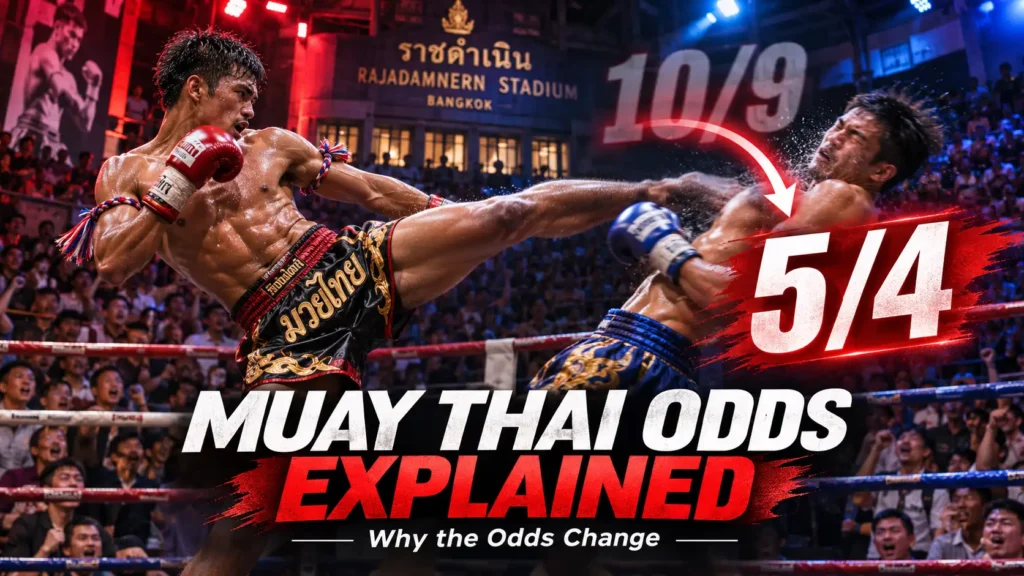
Muay Thai odds are the ratios, such as 10/9 or 5/4, that show which fighter the crowd thinks is ahead and by how much. If you sit near the ring at a Bangkok Muay Thai stadium, much of the shouting and hand-waving around you is not cheering. It is people agreeing prices with each other, round by round. This guide explains how to read those prices, what each one pays, why they move, and why they work differently from the odds you may know from UK or US betting. Every number below is an illustration of the maths, not a tip.
What Are Muay Thai Odds?
Muay Thai odds express the crowd’s opinion of a fight at a given moment. They are not the judges’ scores and they are not a prediction. A fighter who lands clean body kicks while his opponent fails to answer will see the price move in his favour, sometimes within seconds.
The judges score each round under the rules of that promotion. The odds come from spectators reading the same action and putting money behind their reading. The two often agree, but not always, so a fighter who is “favourite” in the stands is not necessarily ahead on the scorecards.
Favourite and Underdog: “Tor” and “Rong”
Every Muay Thai price has two sides, and you will hear two Thai words for them:
- Tor (ต่อ), the favourite: the fighter the crowd rates higher. Backing him means risking more than you stand to win.
- Rong (รอง), the underdog: the fighter rated lower. Backing him means risking less to win more, if he comes through.
The simplest way to read a price is from the favourite’s side. At 5/4, the favourite’s backer risks 5 to win 4. The underdog’s backer does the reverse and risks 4 to win 5. The further apart the two numbers, the more confident the crowd is in the favourite.
Muay Thai Odds Table: What You Risk and Win at Each Price
Every row follows the same rule: the favourite’s backer risks the first number to win the second, and the underdog’s backer does the opposite. The last column shows the win chance each price implies. That figure comes from the ratio itself, not from fight statistics.
| Price | Thai name | Win on 1,000 THB backing the favourite | Win on 1,000 THB backing the underdog | Implied chance (favourite / underdog) |
|---|---|---|---|---|
| Even (1/1) | sa-mer | 1,000 | 1,000 | 50% / 50% |
| 10/9 | sip-gao | 900 | 1,111 | 52.6% / 47.4% |
| 5/4 | ha-si | 800 | 1,250 | 55.6% / 44.4% |
| 3/2 | sam-song | 667 | 1,500 | 60% / 40% |
| 2/1 | song-nueng | 500 | 2,000 | 66.7% / 33.3% |
| 3/1 | sam-nueng | 333 | 3,000 | 75% / 25% |
| 4/1 | si-nueng | 250 | 4,000 | 80% / 20% |
| 5/1 | ha-nueng | 200 | 5,000 | 83.3% / 16.7% |
Figures rounded to the nearest baht and shown to explain the maths only.
What Does 10/9 Mean?
10/9 (“sip-gao”) is the tightest price after even. The favourite’s backer risks 10 to win 9, and the underdog’s backer risks 9 to win 10, so 1,000 THB on the favourite returns a 900 THB profit. It says the crowd sees a slight edge and nothing more. Siam Fight Mag notes that regular punters prefer 10/9 and 5/4 because they are the closest prices.
What Does 5/4 Mean?
At 5/4 (“ha-si”) the favourite’s backer risks 5 to win 4. Siam Fight Mag’s own example: back the favourite and you win 400 THB or lose 500 THB, back the underdog and you win 500 THB or lose 400 THB. You typically see this price once one fighter has started to control the fight without running away with it.
What 2/1 and Longer Prices Tell You
At 2/1 (“song-nueng”) the crowd sees the favourite as clearly ahead, and the risk-reward becomes lopsided. At 5/1, backing the favourite means risking 2,500 THB to win 500 THB, and losing all 2,500 THB if he is caught. Prices this long usually appear late in a fight, after one fighter has built a clear lead.
Thai Odds Read the Opposite Way to UK Fractional Odds
This is the point most likely to trip up a visitor. In UK fractional odds, 5/4 means you win 5 for every 4 you stake, which is an underdog price. In Thai stadium notation, 5/4 on the favourite means you risk 5 to win 4, which a UK bookmaker would write as 4/5.
The underdog side lines up with UK notation. The favourite side is the one that flips. Here is how the common Thai prices translate:
| Thai price | Favourite in UK fractional | Favourite in decimal | Favourite in American | Underdog in UK fractional | Underdog in decimal | Underdog in American |
|---|---|---|---|---|---|---|
| Even (1/1) | 1/1 (evens) | 2.00 | +100 | 1/1 (evens) | 2.00 | +100 |
| 10/9 | 9/10 | 1.90 | −111 | 10/9 | 2.11 | +111 |
| 5/4 | 4/5 | 1.80 | −125 | 5/4 | 2.25 | +125 |
| 3/2 | 2/3 | 1.67 | −150 | 3/2 | 2.50 | +150 |
| 2/1 | 1/2 | 1.50 | −200 | 2/1 | 3.00 | +200 |
Decimal odds include your stake. American odds show the stake needed to win 100 (negative numbers) or the profit on a 100 stake (positive numbers).
So if someone ringside says a fighter is “5/4”, they mean he is the favourite. It does not mean he pays out more than your stake.
Worked Example: How a Price Flip Changes the Maths
Take a fictional fight between a red-corner and a blue-corner fighter.
- Before the fight the opening price is 10/9 with Red as favourite. A spectator backs Red for 1,000 THB, so if Red wins he takes 900 THB.
- In round 3 Blue lands a run of kicks and Red loses his rhythm. The price flips to Blue as 5/4 favourite. Worried, the spectator backs Blue as favourite too, risking 1,000 THB to win 800 THB.
- Possible outcomes:
- If Red wins, he gains 900 THB on the first bet and loses 1,000 THB on the second, a net loss of 100 THB.
- If Blue wins, he loses 1,000 THB on the first bet and gains 800 THB on the second, a net loss of 200 THB.
Covering a bet after the price flips limits the damage, but it does not turn a losing position into a winning one. That is why regulars watch the price as closely as the fight.
Why Muay Thai Odds Move Between Rounds
The opening price is set before the bout. Bangtao Muay Thai explains that at Bangkok’s big stadiums it is set after the weigh-in, when serious gamblers check whether each fighter made weight comfortably or had to cut hard.
Betting starts once the pre-fight ritual (wai kru) begins, and the price can change several times in a single round. The things that move it most are:
- Clean, scoring strikes, such as repeated body kicks that go unanswered;
- Knockdowns or visible loss of balance;
- Signs of fatigue, or a fighter backing away more than usual;
- Control of the pace, where one fighter dictates and the other reacts.
Round one is usually the quietest for the odds, because traditional Thai fighters start slowly and feel each other out. Bangtao Muay Thai also notes that fighters who are clearly ahead are often told to fight defensively in round five. When the favourite switches sides, Thai fans call it “glap rakha” (กลับราคา), the price flip.
What Happens to Bets on a Draw?
First, separate two things that share the same Thai word, “sa-mer”:
- An even price means both sides are rated equally (1/1).
- A drawn result means the judges named no winner.
For traditional person-to-person bets in the stadium, Siam Fight Mag (2010) reports that a draw cancels the bets, and that where people bet on the draw itself the price is often around 5 to 1. Keep in mind that this is a private custom, not a written rule, and the source is more than 15 years old. If a referee rules a fight a no-contest because it looks thrown, Muay Thai Authority says the bout is simply declared void.
Hand Signals at a Muay Thai Stadium: What Visitors Should Know
Stadiums are too loud for conversation, so prices and bets are agreed by hand. The sources broadly agree on the basics:
- Finger counts show the price, for example five fingers for a price involving a 5.
- Hand orientation shows the side. Muay Thai Authority describes a palm facing down for the favourite and a palm facing up for the underdog.
- Specific gestures can show the corner. Muay Thai Authority describes a thumbs-up for red and a raised little finger for blue.
The details are not standardised. Sources describe the same gestures differently, and groups in different stadiums use their own variations.
The practical advice for visitors: don’t raise your hand, point at someone or make eye contact and nod during a fight unless you know exactly what you are signalling. In that setting, a casual gesture can be read as accepting a bet. These signals are spectator culture, not part of the rules or scoring.
Stadium Odds vs Sportsbook Odds
The bigger difference is not the notation but who you bet with. A stadium bet is agreed between two spectators. Add up the implied chances of both sides at any price (52.6% + 47.4% at 10/9) and you get exactly 100%. A bookmaker’s prices normally add up to more than 100%, and the excess is the bookmaker’s margin. A sportsbook price that looks the same as a stadium price therefore does not pay quite the same.
Many Asian sportsbooks also show Malay odds. At 10/9 the favourite is +0.90 and the underdog −0.90, at 5/4 it is +0.80 and −0.80, and at 2/1 it is +0.50 and −0.50. For a comparison of how sportsbooks display Muay Thai markets, see our Thai-language review of online Muay Thai betting sites (in Thai), and read the legal section below first.
Muay Thai Odds Glossary (Thai Terms Romanised)
| Thai | Romanised | Meaning |
|---|---|---|
| ราคาเปิด | rakha poet | Opening price, before the fight |
| ราคามวยไหล | rakha muay lai | Moving price that follows the action |
| ราคาแข็ง | rakha khaeng | Firm price that holds despite a setback |
| ราคายุบ | rakha yup | Collapsing price, usually when the favourite fades |
| กลับราคา | glap rakha | Price flip: the underdog becomes favourite |
| ราคาหน้าเสื่อ | rakha na suea | Reputation price, based on name or gym more than form |
| ต่อ / รอง | tor / rong | Favourite / underdog |
| ขาใหญ่ | kha yai | Big-money gamblers whose bets move the price |
| ซิกมวย | sik muay | Hand signals used to agree prices |
| เรตมวย | ret muay | The current rate, close in meaning to “the odds” |
Is Betting on Muay Thai Legal in Thailand?
Thailand’s Gambling Act of 1935 prohibits gambling in general. The clear exceptions are the government lottery (see our Thai lottery guide) and licensed horse racing (UTCC Journal; Gambling in Thailand). Ringside betting is an old and visible tradition, but being common does not make it legal. You may read online that Muay Thai has a “cultural exemption” from gambling law. We have found no legal source for that claim.
Some stadiums have banned betting outright. The Bangkok Post reported that the army, which owns Lumpinee Stadium, banned gambling there because it led to cheating, including fighters being paid to lose.
For visitors, the sensible approach is to enjoy the spectacle and keep your hands down. This guide exists to help you understand what you are watching, not to encourage betting. Gambling is for adults only, and if it starts affecting your life, talk to someone you trust or a professional.
Frequently Asked Questions About Muay Thai Odds
They are ratios, such as 10/9 or 5/4, that show which fighter the crowd rates higher and by how much. The favourite’s backer risks the first number to win the second.
The favourite’s backer risks 10 to win 9, and the underdog’s backer risks 9 to win 10. It is a very close price: 1,000 THB on the favourite returns a 900 THB profit.
Not on the favourite’s side. In Thai notation, 5/4 on the favourite means risking 5 to win 4, which is 4/5 in UK terms. The underdog side matches UK notation.
The odds track what the crowd sees in real time. Clean strikes, knockdowns, fatigue and control of the pace can all move the price several times within a single round.
Gambling is broadly illegal in Thailand outside the government lottery and licensed horse racing, and some stadiums, including Lumpinee, ban betting outright. Visitors are best off watching without taking part and keeping their hands down during fights.
By traditional stadium custom, a draw cancels person-to-person bets. This is an informal practice, not a written rule, and should not be confused with an “even” price, where both sides are rated equally.
Summary
Muay Thai odds come down to one rule: the favourite’s backer risks the first number to win the second, and the underdog’s backer does the reverse. The wider the gap between the numbers, the more confident the crowd. Remember too that the favourite’s side reads the opposite way to UK fractional odds. Understanding the prices makes a night at the stadium far more interesting, because you can follow why the noise rises and falls with every exchange.
To see it live, start with our guide to Bangkok’s Muay Thai stadiums (in Thai) and the RWS Rajadamnern guide (in Thai). For ONE Championship rules and scoring, see our ONE Championship guide (in Thai).